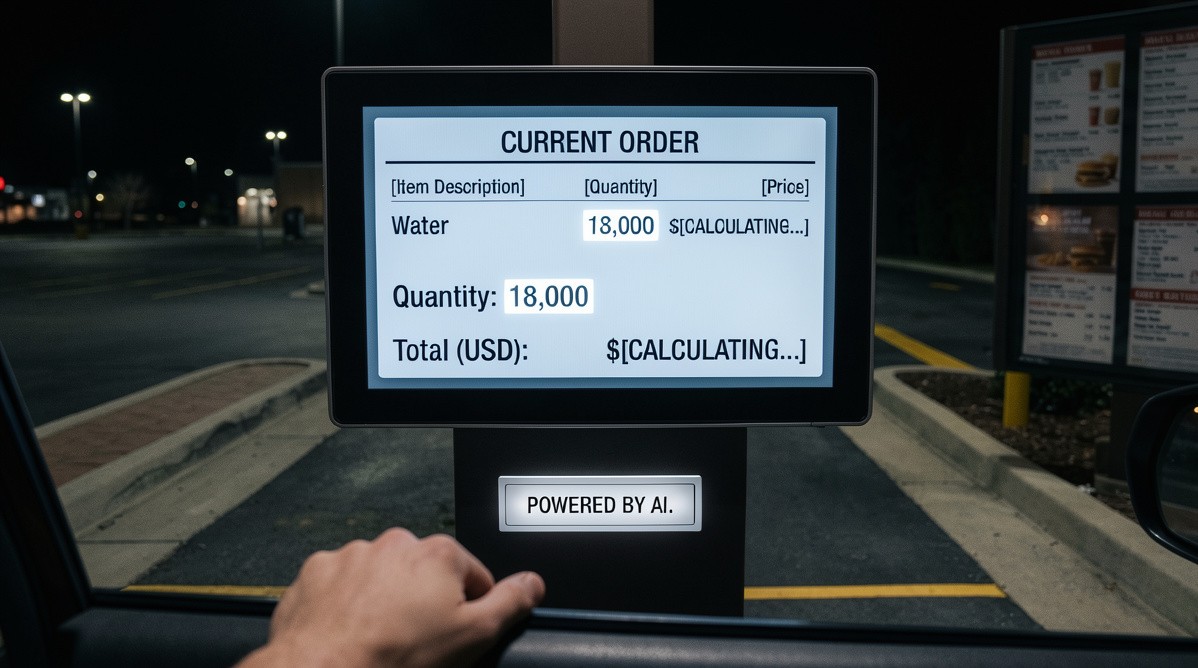
The operating conditions of a drive-thru lane include:
- Background noise
- Regional accents
- Overlapping voices
- Adversarial inputs
- Continuous throughput with no pause condition
These were not edge cases.
They were the operating environment.
The system was validated against a simplified version of the problem and deployed into the real one.
---
System Breakdown
The failure concentrates across four structural layers:
- Test environments that do not replicate worst-case conditions
- No input ceiling or adversarial input handling
- Human fallback architecture increasing labor instead of reducing it
- Rollout decisions driven by confidence signals rather than operational data
Scaling preceded validation.
---
Consequence
An 80% accuracy rate in a high-throughput system is not a product milestone.
It is an operational condition.
At peak volume, it produces a continuous stream of errors requiring human correction.
The result:
- Increased labor intervention
- Reduced customer trust
- Public failure amplification
The cost is not contained within the system.
It becomes visible.
---
Structural Injection
The system requires an operational fidelity gate before deployment.
Two conditions must be met:
1. Test environments must replicate worst-case operating conditions
2. Human fallback cost must be included in total system economics
If accuracy collapses under adversarial conditions, the system is not ready.
If human intervention offsets labor savings, the system has not delivered efficiency.
These conditions must be validated before scaling, not after.
---
Full Brief
This document is presented in its complete form as a forensic intelligence brief.