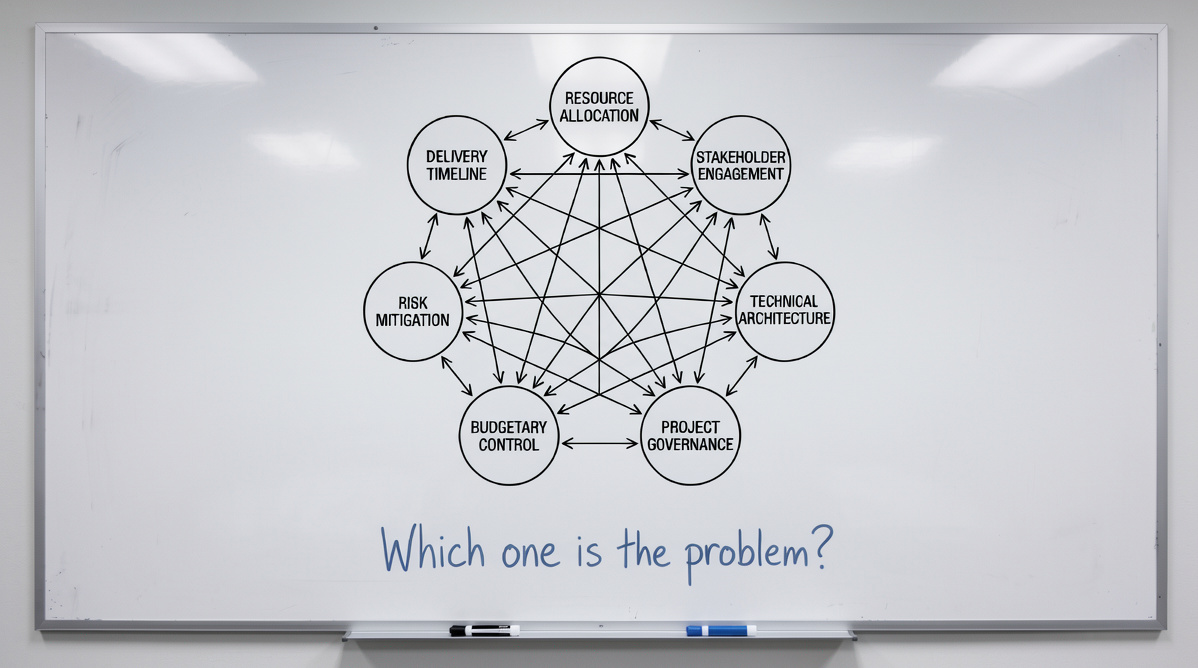
Context + Opening Assertion
The system under examination is organizational transformation frameworks and the structural gap between diagnostic completeness and execution architecture.
The McKinsey 7S Framework correctly identifies that organizations are systems of interdependent elements. That is a genuine structural insight.
It is also where the framework stops.
An organization that completes a rigorous 7S analysis knows what is misaligned. It does not know which misalignment is load-bearing, and in what sequence it must be resolved to produce a different outcome.
---
Structural Diagnosis
Across more than 24,000 transformation initiatives, only 12% achieve their original ambition.
Failure rates have remained stable despite increasing diagnostic sophistication.
Organizations now have more frameworks, more consultants, and more alignment tools than at any point in the discipline’s history.
The outcome has not improved.
The problem is not diagnostic capability.
It is the absence of execution architecture.
---
System Breakdown
The failure concentrates across four structural layers:
- Equal treatment of all misalignments, masking the load-bearing constraint
- No built-in prioritization or execution sequencing
- Verification of alignment rather than verification of output change
- Iteration cycles that refine diagnosis without changing causal hypotheses
The diagnosis is thorough.
The constraint is invisible inside it.
---
Consequence
The organization identifies misalignments, runs workshops, produces reports, and updates internal alignment.
Eighteen months later, the output metric has not moved.
This is not failure in the traditional sense.
It is failure with credentials.
The system produces alignment without outcome.
---
Structural Injection
A system that produces outcomes must answer three questions before intervention:
1. Which single variable is constraining the output?
2. In what sequence must misalignments be resolved?
3. What happens to the output when the constraint is removed?
A misalignment is a diagnostic finding.
A constraint is the variable whose removal changes the result.
Resolving misalignments without isolating the constraint does not change the outcome.
---
Full Brief
This document is presented in its complete form as a forensic intelligence brief.
Public Document
View Public Brief →